

The Layering Conflict: Why Harnesses and Dog Jackets Misalign (And the Smarter Fix)
JulianThorneTL;DR: Stop Layering Harnesses Over Winter Coats. Putting a traditional harness over or under a thick dog jacket creates constant friction. Outer straps squash the jacket's insulation—letting cold air in—while inner harnesses rarely align with leash slits, pulling awkwardly against your dog's neck. A unified Integrated Harness Jacket solves this entirely: it keeps the coat fluffy and warm while distributing leash pull safely across the chest for smooth, strain-free winter walks.
If you've ever wrestled a shivering dog into a thick winter coat, only to spend another five minutes fighting to buckle a bulky harness over (or under) it, you know how frustrating winter walks can be. Do you strap heavy nylon webbing over the coat and crush its fluffy insulation? Or do you try to thread a leash through an awkward coat slit that never stays aligned?
Forcing separate gear to work together isn't just a hassle before heading out—it actually ruins the coat's warmth and puts uncomfortable strain on your dog's neck and joints. To keep your dog warm, safe, and moving naturally, we need to look at why traditional layering fails, and why a Waterproof Integrated Harness Jacket is the ultimate game-changer for cold-weather adventures.
3 Ways Pet Parents Pair Winter Coats with Leashes (And Their Hidden Flaws)
Most dog parents use one of three common methods to keep their pup warm and attached to a leash. However, forcing separate gear together often causes hidden comfort and safety issues. Let's look at the reality of each setup:
Harness OVER the Coat (The Heat-Sleeper Trap): Buckling a traditional harness on top of a winter jacket seems quick, but it has major downsides:
- Crushes Insulation: Heavy nylon straps press down on the coat, squishing its fluffy insulation. Once the coat loses its "puff," cold air leaks right in, robbing your dog of body heat.
- Causes Chafing: As your dog walks, loose straps rub back and forth against the coat’s slick synthetic fabric, creating friction points and restricting natural shoulder movement.
Harness UNDER the Coat with a Leash Slit (The Misalignment Mess)
This common setup involves putting the harness underneath the jacket and threading the leash through a small cut-out hole on the back.
The Only Pro: It keeps the inner harness clean and dry from mud, rain, or snow.
The Major Cons & Risks:
- The Fumble Factor: Because harness sizes and D-ring locations vary wildly, that tiny coat hole seldom aligns perfectly with the ring inside. You end up fumbling blindly through cold fabric layers just to clip the leash—a total nightmare with an excited dog.
- Uneven Neck & Spine Strain: As your dog moves, the jacket shifts. When they pull, the leash yanks against the rigid edge of the misaligned hole instead of pulling the harness straight. This creates an awkward, sideways pulling force that presses directly against your dog's neck and spine, disrupting their natural stride and causing long-term joint strain.
The Ultimate Fix—The Integrated Harness Jacket
Instead of forcing two separate pieces of gear together, an integrated jacket embeds heavy-duty leash rings directly into the coat's outer shell. This unified design solves both thermal and safety issues in one go:
- Maximum Warmth (Zero Compression): Because there are no outer straps squeezing the coat down, the interior insulation stays fluffy and fully puffed—locking in body heat and sealing out freezing winter wind.
- Safe & Balanced Pulling: When your dog pulls, the tension is distributed evenly across their chest and sternum—never their neck, throat, or spine. This protects their skeletal alignment, prevents choking, and lets them walk and run with complete freedom.
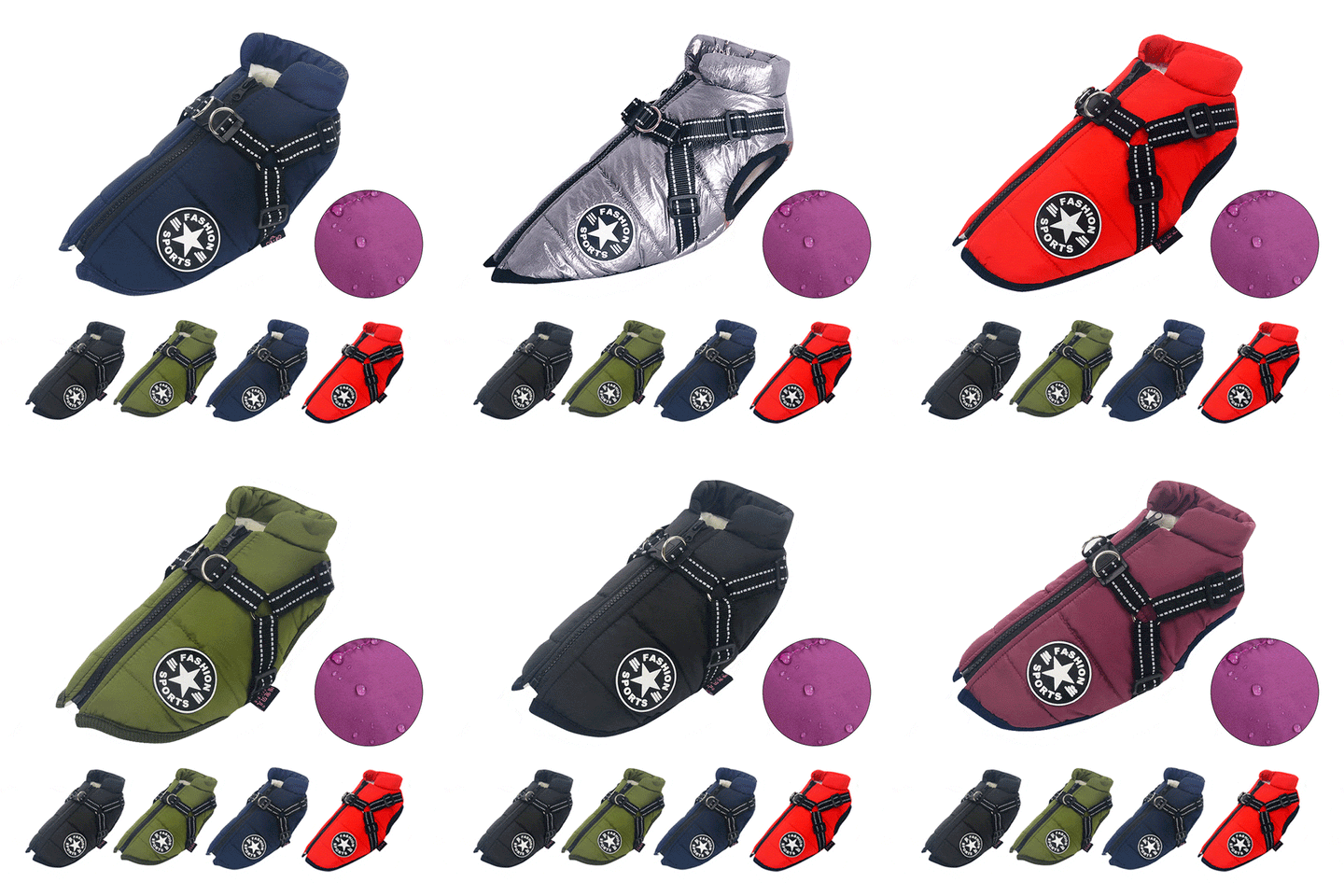
The Core Engineering Advantages: Built for Sub-Zero Transit
By fusing control and insulation into a singular matrix, the Dogegis™ integrated chassis framework delivers three distinct practical advantages over traditional multi-piece layering:
- Optical Luminance & Low-Light Safety: Traditional harnesses are completely obscured when worn underneath winter coats, sacrificing canine visibility. A professional waterproof harness jacket features high-visibility reflective safety bands cross-stitched directly onto the exterior hydrophobic shell, ensuring immediate optical detection during dark winter mornings or low-visibility, foggy evening transits.
- Defensive Thermal Seal: Because the exterior harness chassis elements maintain zero inward pressure on the interior insulation, the synthetic composite lining preserves its structural puffiness. This creates an uncompromised dead-air barrier driven by biomimetic self-warming properties, actively protecting your dog from systemic cold stress and shivering while locking down a stable, warm thermodynamic micro-climate even during extended exposure to heavy snowfall.
- The "High-Efficiency" Deployment: Eliminate the anxiety-inducing pre-walk wrestling match. Engineered with an industrial-grade resin back zipper, the step-in geometry allows handlers to mitigate anxiety instantly by transforming a chaotic routine into a calm, sensory-neutral sanctuary. You simply position the dog, slide the enclosure securely, and clip the leash directly to dual reinforced tensile D-rings. It functions as a seamless, cold-weather harness replacement that drastically reduces joint strain for impatient senior dogs, preserves natural gait mechanics, and saves valuable time for the handler while securing immediate orthopedic comfort.
The Active Transit Audit: 3 Non-Negotiable Essentials
Before initiating your next high-exposure winter transit, systematically audit your current cold-weather gear against these three technical specification baselines:
- Hydrophobic Integrity: Does the textile feature a certified waterproof membrane that actively sheds freezing sleet, heavy rain, and melting snow? If the fabric absorbs moisture, it shifts from an insulator to a thermal liability, triggering severe systemic cold stress.
- Cervical Micro-Climate Protection: Does the jacket design incorporate an adjustable, high-retention windproof collar? The laryngeal and cervical pathways are highly sensitive to sudden drop-convection. Leaving the neck exposed allows freezing gusts to bypass the torso seal, disrupting the entire thermodynamic micro-climate and rapidly lowering baseline core temperatures.
- Tensile Cleanability: Winter exploration inevitably introduces mud, slush, and corrosive de-icing salts. Can the entire integrated chassis framework withstand high-torque, machine-washable sanitation cycles without compromising the structural box-stitching of the harness matrix?
The Dogegis™ Waterproof Harness Jacket satisfyingly achieves all three engineering benchmarks, preserving natural gait mechanics and securing uncompromised orthopedic comfort through every rugged winter mile.

FAQ: Mechanical & Thermal Integration
Q: Does an external harness over an insulated jacket compromise its thermal value?
A: Yes, layering bulky, non-elastic straps over an insulated coat can compress the garment's internal loft. This reduces the trapped air space (the boundary layer) required to retain metabolic body heat, leading to increased conductive heat loss. Integrated harness jackets circumvent this by anchoring tensile straps to the exterior structural matrix, leaving the insulation layer uncompressed and fully effective.
Q: My current winter coat features a built-in leash slit, but the underlying harness continuously slips out of alignment. How can this layout flaw be corrected?
A: This misalignment is an inherent geometric defect of the "Harness Under" method. Because the independent harness and the jacket shift along different kinetic planes during locomotion, the aperture creates an immediate friction anchor that pulls unevenly against your dog's cervical spine and trachea. This defect induces sudden mechanical anxiety, shatters their sensory-neutral sanctuary, and disrupts natural gait mechanics. The only permanent resolution is migrating to a unified system that eliminates the structural slit, securing dual exterior tensile D-rings directly onto a static dorsal platform to safeguard long-term orthopedic comfort.
Q: Is an integrated harness chassis structurally robust enough to handle high-torque pulling or reactive dogs?
A: Engineered integrated jackets do not rely on fragile fashion seams to secure your animal. High-performance models route heavy-duty, load-bearing tactical webbing entirely through the internal core matrix of the coat, anchoring it with military-grade box-stitching to form a rigid integrated chassis framework. When a dog pulls, the kinetic energy is bypassed around the fabric shell and distributed uniformly across the solid skeletal frame (the sternum and ribcage). This layout delivers targeted deep pressure decompression to mitigate anxiety during high-torque moments while preserving pristine gait mechanics with identical tensile security to a standalone premium harness.
Q: What is the mandatory protocol for laundering a winter coat that contains a built-in harness matrix?
A: Specialized utility gear requires precise maintenance to preserve its defensive coatings. Fully close the heavy-duty resin back zipper and secure all fasteners to eliminate friction damage during the cycle. Machine wash exclusively on a cold, delicate setting using a mild, non-detergent technical wash to protect the exterior hydrophobic membrane. Always air dry; the intense thermal energy of commercial dryers will degrade both the technical fabrics and the integrity of the synthetic internal webbing fibers over time. Once dry, your jacket is ready to instantly deploy as a clean, high-efficiency sensory-neutral sanctuary for the next sub-zero transit.
Conclusion: Engineering Seamless Sub-Zero Transit
You shouldn't have to compromise between raw thermodynamic protection and reliable tensile control. By upgrading your cold-weather gear to a high-performance waterproof harness jacket driven by a rigid integrated chassis framework, you streamline your pre-walk prep and dramatically enhance your dog’s long-term orthopedic comfort.
- The Tactical Reality: Do not let ambient room drafts or freezing outdoor precipitation restrict your companion's natural gait mechanics.
- The Complete Loop: Transitioning to a unified system shields their vital organs from systemic cold stress during high-exertion transit, allowing them to return home and safely recalibrate their core temperature inside an indoor, engineered sensory-neutral sanctuary.
- The Ultimate Defense: Reclaim the joy of winter exploration by establishing a flawless thermodynamic micro-climate that safeguards both their physical skeleton and emotional stability.
Don't let the elements stop your adventures.
👉 [Shop the Dogegis™ Waterproof Harness Jacket & High-Performance Winter Collection]


